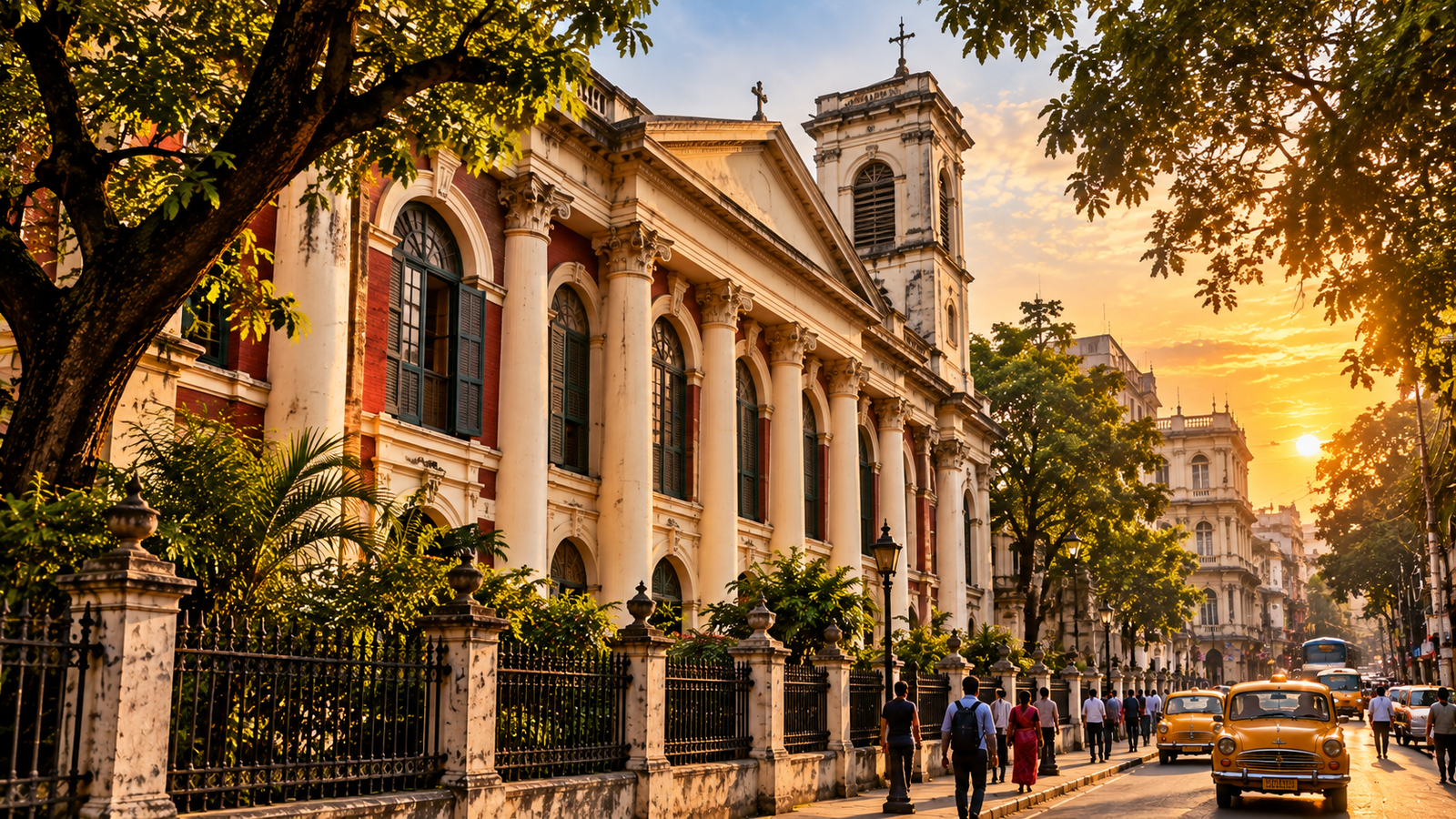


There are places in Kolkata that can be seen, and there are places that can be felt.
The Howrah Bridge symbolizes movement, the Victoria Memorial reflects imperial grandeur, and College Street embodies Bengal’s intellectual awakening. But hidden amid the ancient trees of Alipore stands a building that combines all these emotions—history, knowledge, nostalgia and mystery.
The National Library of India is not merely a repository of books. It is a witness to empires, betrayals, revolutions, love affairs, political conspiracies and countless human memories. More intriguingly, it is also widely regarded as one of Kolkata’s most haunted places.
How did India’s largest library acquire such a reputation?
To understand the mystery, one must first understand Kolkata itself.
The Birth of Belvedere: Before It Became a Library
Long before it housed millions of books, the National Library was known as Belvedere House, situated within the sprawling Belvedere Estate in Alipore. Historians generally associate the estate with Nawab Mir Jafar during the eighteenth century, after the political upheavals that followed the Battle of Plassey. Later, the estate became connected with Warren Hastings, the first Governor-General of Bengal.
The name “Belvedere” itself means “beautiful view.”
And indeed, eighteenth-century Alipore was a landscape of gardens, riverside breezes and grand colonial residences. The estate represented the transition of Bengal from Mughal influence to British domination.
Belvedere became more than a residence; it became a symbol of power.
Within its walls, administrative decisions were made that would alter the destiny of India.
Warren Hastings and the Shadows of Empire
No historical narrative of the National Library can ignore Warren Hastings.
Hastings was one of the most influential and controversial figures of British India. Stories surrounding his life, political rivalries and personal relationships continue to fuel legends even today.
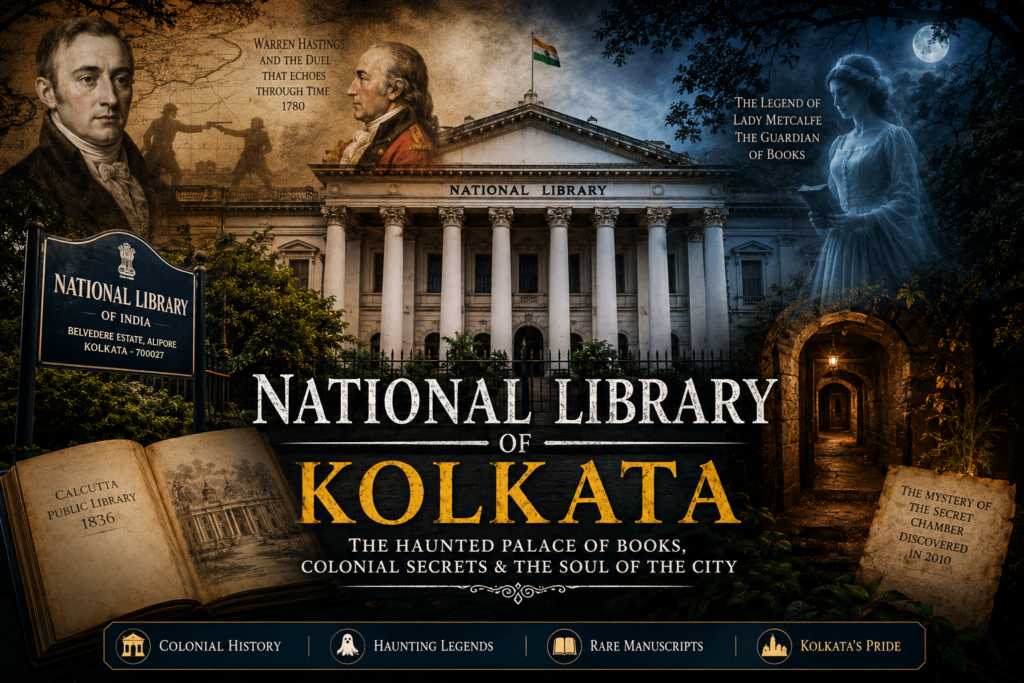
One of the most dramatic events associated with Belvedere Estate was the famous duel between Warren Hastings and Sir Philip Francis in August 1780. The confrontation arose from intense political and personal rivalry. Francis was seriously wounded during the duel, and folklore claims that traces of this violent episode continue to linger around the estate.
Kolkata has always preserved its memories through stories.
And stories, when repeated for centuries, often become legends.
From Imperial Residence to National Treasure
After the British administrative centre shifted and political circumstances changed, Belvedere House passed through several phases of usage.
Meanwhile, another institution was emerging.
The Calcutta Public Library, established in 1836, became one of the earliest public libraries in India. During the colonial era, it evolved into the Imperial Library and eventually, after India’s independence, was transformed into the National Library of India. The library formally assumed its national role in the early years of independent India and moved into Belvedere Estate.
This transformation itself is symbolic.
A palace once associated with colonial authority became the democratic home of knowledge.
The building that once represented imperial power was reborn as a sanctuary for scholars, students and researchers.
Few structures in India embody such a profound historical irony.
National Library and Kolkata: An Emotional Relationship
Kolkata cannot be separated from books.
This city gave birth to the Bengal Renaissance, modern Indian nationalism, revolutionary thought and literary giants like Bankim Chandra Chattopadhyay, Rabindranath Tagore and Sarat Chandra Chattopadhyay.
The National Library became a continuation of this intellectual heritage.
For generations of students preparing for civil services, researchers exploring forgotten manuscripts, and historians seeking archival records, the library became almost sacred.
The silence of its reading rooms possesses a unique character.
It is not empty silence.
It is the silence of accumulated wisdom.
The scent of old paper, wooden corridors, fading sunlight filtering through colonial windows—everything inside the library seems to preserve another century.
This emotional attachment is why many Kolkatans refer to the National Library not merely as a building but as a living memory of the city itself.
Why Is National Library Called Kolkata’s Most Haunted Place?
Every old city possesses its ghost stories.
And Kolkata perhaps possesses more than most.
The National Library occupies a special place in these narratives.
Over the decades, numerous readers, security personnel and visitors have reported unusual experiences.
Some claim to have heard footsteps in empty corridors.
Others describe the sensation of someone breathing behind them while reading.
Some mention pages turning mysteriously or hearing the sounds of palanquins and horse-drawn carriages during late hours.
The stories are so persistent that the National Library has become one of the most famous haunted locations in India.
But who are these supposed spirits?
The Legend of Lady Metcalfe
Perhaps the most famous ghost associated with the library is that of Lady Metcalfe.
According to popular legend, Lady Metcalfe was deeply passionate about books and discipline. The story suggests that even after death, she continues to wander the corridors, ensuring books remain in their proper places.
Readers have occasionally claimed to feel an unseen presence while sitting alone.
Some insist they felt someone standing beside them.
Others claim to have sensed disapproval if books were mishandled.
Whether true or imagined, the story perfectly suits Kolkata—a city where literature itself often seems alive.
The Blood of the Duel
Another legend returns us to Warren Hastings and Philip Francis.
The duel of 1780 remains deeply embedded in Kolkata’s historical imagination.
Some accounts describe sightings of a pale European figure, wounded and bleeding, moving through the grounds of Belvedere Estate.
There are tales of ghostly carriages and mysterious shadows appearing during moonlit nights. Local folklore even speaks of spectral palanquins crossing the lawns.
Historically, there is no evidence supporting such supernatural claims.
Yet legends often reveal emotional truths.
The violent and turbulent history of colonial Bengal left deep psychological impressions upon the city.
Ghost stories may simply be Kolkata’s poetic way of remembering its past.
The Mystery of the Secret Chamber
The haunted reputation of the National Library intensified dramatically in 2010.
During restoration work, archaeologists reportedly discovered a mysterious sealed chamber within the structure. The room appeared to have no obvious entrance or staircase, immediately generating enormous public curiosity. Speculations ranged from hidden treasure chambers to secret prisons and even tombs. Later investigations suggested that it was likely an architectural cavity filled with mud, designed to strengthen the building’s foundations.
Yet for Kolkata, the mystery had already become immortal.
Because Kolkata loves unanswered questions.
The city lives through mysteries.
Why Haunted Stories Flourish in Kolkata
To understand why the National Library is considered haunted, one must understand the character of Kolkata.
This is a city where colonial architecture still dominates the skyline.
Ancient cemeteries lie beside modern apartment complexes.
Old mansions remain occupied by memories of vanished aristocracies.
The city possesses an unusual relationship with time.
Past and present coexist here.
In such an environment, ghost stories become almost inevitable.
The National Library, with its vast silent corridors, towering trees, colonial history and centuries of accumulated memory, naturally became fertile ground for legends.
Perhaps the building is not haunted by spirits.
Perhaps it is haunted by history itself.
The National Library as a Symbol of Kolkata
For historians, the National Library represents much more than paranormal folklore.
It symbolizes the evolution of Kolkata.
It narrates the transition from Nawabi Bengal to British imperialism, from colonial administration to independent India.
Its shelves preserve newspapers that documented revolutions, manuscripts that shaped literature and records that explain the making of modern India.
Millions of books rest quietly within its walls.
Every page represents another human life, another forgotten memory.
The National Library is therefore not merely India’s largest library.
It is one of the greatest memory vaults of South Asia.
And perhaps this is why people feel strange emotions within its premises.
Because history itself can be overwhelming.
Conclusion: Where Books and Ghosts Share the Same Corridors
As evening descends upon Alipore and shadows lengthen across the lawns of Belvedere Estate, the National Library assumes a different personality.
The colonial façade becomes darker.
The ancient trees whisper with the wind.
The silence deepens.
Whether one believes in ghosts or not, it is impossible to deny the extraordinary atmosphere of this place.
For historians, it is a priceless archive.
For bibliophiles, it is a temple of knowledge.
For storytellers, it is an endless source of mystery.
And for Kolkata, it is something even greater.
It is a reminder that cities are not built only with bricks and roads.
They are built with memories.
The National Library stands as one of Kolkata’s greatest memories—majestic, mysterious and eternal.
Perhaps the real ghosts of the National Library are not spirits at all.
They are the countless forgotten stories waiting patiently on dusty shelves, hoping that someday, someone will open a book and bring them back to life.