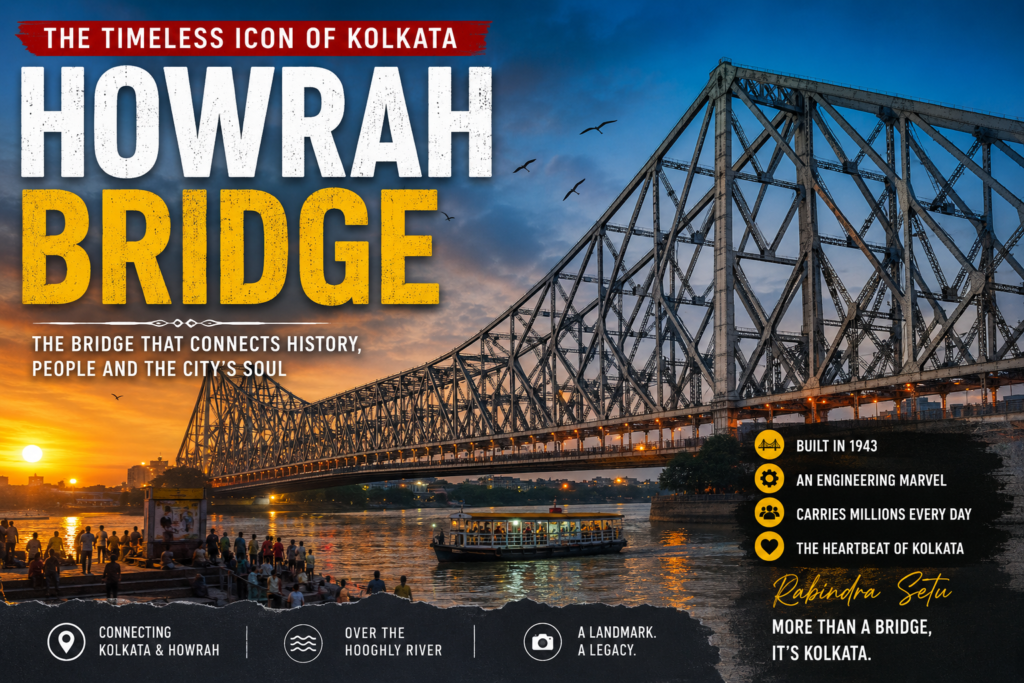

There are many landmarks that define a city. Some are famous because of their architecture, some because of their history, and some because they become inseparable from the everyday life of the people who live around them.
For Kolkata, the Howrah Bridge is all three.
Standing majestically over the Hooghly River, the Howrah Bridge is not simply a structure connecting Kolkata and Howrah. It is one of the most recognisable symbols of the city and an inseparable part of Kolkata’s visual identity. Officially known as Rabindra Setu, the bridge has witnessed decades of political change, economic transformation, cultural movements, celebrations, tragedies and the ordinary daily journeys of millions of people.
The bridge connects two sides of the Hooghly, but its importance goes far beyond transportation. It connects Kolkata’s past with its present.
Today, visitors may photograph it from the riverfront, watch its silhouette during sunset, cross it while travelling to Howrah Station, or simply see it from a distance. Yet behind the familiar steel structure lies a remarkable story of engineering, industrial development and urban history.
The History of Howrah Bridge
The story of the Howrah Bridge begins long before the present structure was built.
As Kolkata developed into an important commercial and administrative centre, communication between Kolkata and Howrah became increasingly important. Howrah, located on the western bank of the Hooghly River, developed as an important industrial and railway centre, while Kolkata grew as a major urban and commercial hub.
For many years, a pontoon bridge served as the primary connection between the two sides. However, increasing traffic and the limitations of the floating structure created the need for a stronger and more permanent crossing.
The idea of constructing a permanent bridge over the Hooghly was discussed for decades. According to the official Incredible India tourism portal, the proposal for a bridge dates back to the 19th century, while detailed planning and engineering discussions continued over many years.
Eventually, the decision was taken to construct a new bridge capable of handling the growing movement between Kolkata and Howrah.
Construction of the present bridge began in the late 1930s. The project was undertaken during a particularly challenging period in world history, with the Second World War creating enormous difficulties for the supply of construction materials.
The bridge was eventually opened to traffic on 3 February 1943. Because of the ongoing war, the opening was deliberately low-key rather than being celebrated with a large public ceremony.
The bridge was initially known as the New Howrah Bridge.
In 1965, it was officially renamed Rabindra Setu, in honour of Nobel laureate Rabindranath Tagore. However, for generations of people, the name Howrah Bridge remained deeply embedded in everyday language.
Even today, most people in Kolkata and beyond continue to call it the Howrah Bridge.
An Extraordinary Engineering Achievement
One of the most fascinating aspects of Howrah Bridge is its engineering.
The bridge is a balanced cantilever bridge, a design that was highly sophisticated for its time. Instead of relying on conventional supporting arrangements, its massive steel structure extends from the main towers and supports the suspended central portion.
The bridge has a total length of approximately 705 metres, with a main span of around 457 metres. It is approximately 21.6 metres wide and has pedestrian footpaths on both sides.
The structure was designed by the British engineering firm Rendel, Palmer and Tritton, while construction and erection work was carried out by the Braithwaite Burn & Jessop Construction Company.
But perhaps the most remarkable detail is the way the bridge was assembled.
The main steel structure was constructed using rivets rather than conventional nuts and bolts. This feature has become one of the most famous facts associated with Howrah Bridge.
During the Second World War, obtaining steel from Britain became extremely difficult because industrial resources were being diverted towards the war effort. A major portion of the steel required for the bridge was therefore produced in India, with Tata Steel playing a crucial role in supplying the high-tension steel.
This makes the Howrah Bridge more than just a colonial-era engineering project. It is also a remarkable example of Indian industrial capability during a difficult period.
Howrah Bridge and the Hooghly River
The Hooghly River is central to Kolkata’s history.
For centuries, the river has influenced the city’s trade, transportation, industry and culture. The Howrah Bridge stands directly within this historic landscape.
From the bridge, the river stretches into the distance while boats and vessels move beneath the enormous steel structure. On either side, the urban landscape of Kolkata and Howrah creates a dramatic contrast with the flowing water.
The relationship between the bridge and the river is one reason why photographs of Howrah Bridge have become almost synonymous with Kolkata.
At sunrise, the steel structure can appear almost silver against the morning sky. At sunset, the bridge takes on a completely different character. After dark, the illuminated structure creates another iconic Kolkata image.
The bridge is therefore not merely infrastructure. It has become part of the city’s visual culture.
The Gateway to Kolkata
The Kolkata Municipal Corporation describes Rabindra Setu as the “Gateway of Kolkata.”
The description is particularly appropriate because Howrah Bridge has historically been one of the most important entry points into the city.
For countless passengers arriving at Howrah Station, crossing the bridge means entering Kolkata.
For commuters travelling in the opposite direction, it represents the route back towards Howrah.
For businesses, workers, students, traders and visitors, the bridge has long been part of everyday movement across the Hooghly.
The Howrah District Administration notes that the bridge connects Howrah and Kolkata and continues to carry enormous volumes of vehicles and pedestrians every day.
That is what makes the bridge unique.
Many historic monuments are preserved primarily as tourist attractions. Howrah Bridge, by contrast, remains a living piece of infrastructure.
People do not simply visit it.
They use it.
A Bridge That Became Part of Everyday Kolkata
Perhaps the greatest achievement of Howrah Bridge is not its engineering record but its relationship with ordinary people.
A taxi driver crossing the bridge early in the morning, a worker walking towards Kolkata, a student travelling for college, a traveller heading towards Howrah Station, a street vendor carrying goods, or a tourist seeing the structure for the first time — all experience the bridge differently.
For some, it is simply part of the daily commute.
For others, it is the first image they associate with Kolkata.
This is how landmarks become cultural symbols.
The bridge has appeared countless times in photographs, films, documentaries, paintings, advertisements and travel stories about Kolkata. Its distinctive steel framework has become one of the easiest ways to visually identify the city.
When people think of Kolkata, images of yellow taxis, trams, Howrah Station, the Hooghly River and Howrah Bridge often appear together.
The Bridge and Kolkata’s Cultural Identity
Kolkata is a city where history remains visible in everyday life.
Colonial architecture exists alongside modern buildings. Traditional markets operate alongside shopping malls. Old neighbourhoods coexist with new developments.
Howrah Bridge represents this combination perfectly.
It is an engineering structure from another era, yet it continues to serve a modern city.
It has survived changing governments, changing transportation systems, industrial transformation and enormous growth in the metropolitan population.
The bridge has therefore become more than a physical connection. It represents continuity.
Generations of Kolkata residents have crossed the same steel structure. Parents who once crossed it as children later crossed it with their own children. Visitors who first saw the bridge decades ago may return today and find that, despite all the changes around it, the bridge remains recognisable.
That sense of continuity gives Howrah Bridge a special emotional value.
The Lights of Rabindra Setu
Howrah Bridge becomes especially spectacular after sunset.
Its illumination has added another dimension to its identity as a Kolkata landmark. The bridge has been used for special lighting displays on important national and social occasions.
In 2020, the bridge received decorative architectural illumination with energy-efficient LED technology and a synchronised light-and-sound show.
In later years, the bridge has continued to be illuminated for important occasions, including national celebrations.
These lighting programmes demonstrate how the historic structure can become part of contemporary public celebrations without losing its architectural identity.
At night, the steel framework against the dark sky and the reflections on the Hooghly create one of Kolkata’s most memorable urban scenes.
Howrah Bridge and Modern Kolkata
Kolkata has changed dramatically since Howrah Bridge opened in 1943.
Traffic has increased. The city’s population has expanded. New roads and bridges have been built. The Vidyasagar Setu, popularly known as the Second Hooghly Bridge, was constructed partly to reduce pressure on Howrah Bridge. The Howrah District Administration notes that Vidyasagar Setu was built to help reduce congestion on Howrah Bridge.
Yet Howrah Bridge remains indispensable.
That continued relevance is remarkable.
A structure designed more than eight decades ago still functions as one of the major transportation links between Kolkata and Howrah.
The bridge’s survival is also a story of maintenance and preservation. As the structure is exposed to traffic, weather and the river environment, regular inspection and maintenance are essential for protecting its steel framework.
The bridge is currently under the custodianship of the Syama Prasad Mookerjee Port, Kolkata, formerly known as Kolkata Port Trust. The National Portal of India identifies the port authority as responsible for maintenance and repair work related to the bridge.
Why Howrah Bridge Still Matters
In an age of modern cable-stayed bridges, expressways and high-speed transportation infrastructure, one might ask why an old steel bridge continues to attract so much attention.
The answer lies in its identity.
Howrah Bridge is not famous simply because it is old.
It is famous because it has remained useful.
It has carried generations of commuters while simultaneously becoming a symbol of Kolkata. Its importance is therefore both practical and emotional.
The bridge tells the story of a city that constantly changes but never completely forgets its past.
Its steel structure reflects industrial history. Its location reflects Kolkata’s relationship with the Hooghly. Its daily traffic reflects the city’s economic life. Its photographs reflect its cultural importance. And its continued use reflects its practical significance.
A Landmark That Belongs to Everyone
Perhaps the most beautiful thing about Howrah Bridge is that it does not belong exclusively to tourists, historians, engineers or photographers.
It belongs to the people of Kolkata.
A tourist may see an architectural masterpiece.
An engineer may see an extraordinary example of balanced cantilever construction.
A historian may see a structure born during the turbulent years of the Second World War.
A commuter may simply see the road home.
A filmmaker may see one of the most recognisable backdrops in India.
A child seeing the bridge for the first time may simply think it is enormous.
All of these interpretations can exist at the same time.
That is what makes Howrah Bridge special.
Howrah Bridge: More Than Steel and Rivets
More than eight decades after its opening, Howrah Bridge continues to dominate one of Kolkata’s most important urban landscapes.
It has survived the passage of time because it was built not merely as a monument but as a functioning bridge designed to connect people.
Its steel may have been manufactured and assembled with extraordinary engineering precision, but its real legacy has been created by the millions of people who have crossed it.
The name may officially be Rabindra Setu, but for generations, the words Howrah Bridge have carried a deeper meaning.
They evoke Kolkata.
They evoke the Hooghly.
They evoke Howrah Station, busy roads, endless pedestrians, morning rush hours, evening lights and the unmistakable skyline of the city.
And perhaps that is why, even after all these years, Howrah Bridge remains one of the most powerful symbols of Kolkata.
It is not simply a bridge between Howrah and Kolkata.
It is a bridge between generations, between history and modernity, and between the Kolkata that once was and the Kolkata that continues to evolve.
Quick Facts About Howrah Bridge
Official Name: Rabindra Setu
Popular Name: Howrah Bridge
Location: Kolkata–Howrah, West Bengal
River: Hooghly River
Opened: 3 February 1943
Type: Balanced cantilever bridge
Main Span: Approximately 457 metres
Total Length: Approximately 705 metres
Primary Material: Steel
Major Engineering Firms: Rendel, Palmer and Tritton; Braithwaite Burn & Jessop Construction Company
Current Custodian: Syama Prasad Mookerjee Port, Kolkata
Named After: Rabindranath Tagore
Frequently Asked Questions About Howrah Bridge
When was Howrah Bridge built?
The present Howrah Bridge was constructed during the late 1930s and early 1940s and was opened to traffic on 3 February 1943.
What is the official name of Howrah Bridge?
The official name of Howrah Bridge is Rabindra Setu. It was renamed in honour of Rabindranath Tagore.
Where is Howrah Bridge located?
Howrah Bridge connects Kolkata and Howrah across the Hooghly River in West Bengal.
Why is Howrah Bridge famous?
It is famous for its historic importance, distinctive steel architecture, engineering design, enormous daily traffic and its role as one of Kolkata’s most recognisable landmarks.
Is Howrah Bridge still in use?
Yes. It remains a major functioning transportation link between Kolkata and Howrah and carries large volumes of vehicles and pedestrians every day.
Why is Howrah Bridge important to Kolkata?
Beyond transportation, Howrah Bridge has become a cultural and visual symbol of Kolkata. It represents the city’s history, industrial development, connection with the Hooghly River and everyday urban life.
For KolkataNarrative.in:
Howrah Bridge is not merely a story about architecture. It is a story about Kolkata itself — a city that changes every day while carrying its history forward.
#Kolkata #HowrahBridge #RabindraSetu #KolkataHistory #KolkataHeritage #HooghlyRiver #WestBengal #KolkataNarrative